Showing posts with label bread. Show all posts

Thursday, August 4, 2011

Mie and Sandwiches - French Bread II

Coming from an English background in South Africa allows me to look at the sandwich from a few different perspectives.

Sandwiches are named after John Montagu, the 4th Earl of Sandwich who had servants bring him food in bread, to allow him to eat while continuing his other activities. The question seems to be whether this was to allow him to do his political paperwork or play cards while eating.

John Montagu 4th Earl of Sandwich from Wikimedia Commons

First a bit of definition - the french loaf consists of two parts the "croûte" and the "mie". In English there is no word for mie. So when we look at a loaf its bread and crust, while the French see bread, crust and mie. In fact they call a loaf of English type bread "pain de mie"!

I it's interesting to contrast three sandwiches which I believe characterise the cultures within with they are used.

The first - like those most sought after egg sandwiches of Mrs M at the CSIR in the old days or a proverbial cucumber sandwich. These are neat and precise much like the "upper crust" English who have them for tea!

English tea party cucumber sandwiches | Flickr  Photo Sharing
image from Flickr


They are produced by adding the filling (which could be cucumber, sandwich spread, egg mayonnaise, marmite or similar) between two thin slices of bread (pain de mie) which then has the crusts removed and are cut into more manageable portions.

The second - a much heartier sandwich, more a meal rather than something to have with tea! The base for this is a good baguette sliced lengthways and completed with a simple quality filling. The filling is most likely to be ham, saucisson or cheese, possibly ham and cheese but not simply a long loaf stuffed with all the deli sandwich making ingredients possible!
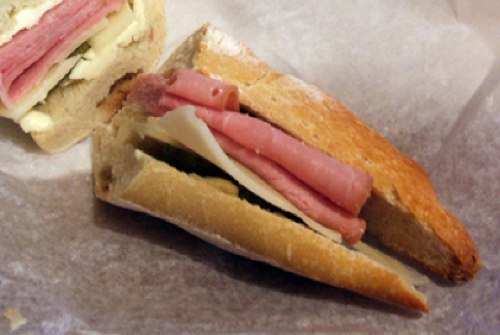
Ham sandwich at La Baguette
image from Flickr


Size can vary, just as the baguette varies - the other day lunching on a merguez roll at a cafe, I watched as two leather clad bikers ripped into sandwiches the size and of an American Football. This worked quite well until a rather petit young woman was served the same sandwich and was reduced to gasping and pulling small mouthfuls off the bread.

The third - the quarter loaf which is two very thick slices of a white loaf filled with a meal often chips, processed meat and achaar. The quarter loaf in Gauteng is similar to the Gatsby in the Western Cape, both going back to the original intent of Lord Sandwich to provide an easy way to eat a meal.

An Enormous Gatsby Sandwich
image from a blog


The quarter loaf is a rough, ready and affordable way of eating a hearty meal with little finesse. A colleague even insisted, that when she was at school they placed quarter loaves under the wheels of parked cars about to drive off to get a compressed sandwich.


Friday, June 24, 2011

French Bread 1 - Carbon Footprints & Global Warming Around The Bakery

The fact that "casser la croûte", which literally means break the crust, can mean such diverse things as have dinner, take a bite, have a snack, munch, grab a bite and eat indicates how central bread is to eating in France!

Bread is part of all French  meals
photograph by ChigyTweet
published under a Creative Commons Attribution-NonCommercial-ShareAlike license.


The Baguette is probably the most eaten bread in France and definitely the one anglophones think of as "French Bread". It is very different to the bread sliced bread most popular in anglophone countries, mainly as the crust is what one looks for in the baguette while its the part left in sliced bread.

There are lots of interesting things to talk about in baking and bread in France, some of which I will cover in later posts. This time I find it interesting to look at the environmental impact of bread and the way its bought.

Get up early in the morning, go to a bakery and see Frenchmen coming in to get bread for their breakfast - yesterdays bread is not fresh and crispy enough for a good tartine! If you are at a bakery in a village, its striking that many people drive to collect their bread.

What is interesting from a global waring viewpoint is how the carbon footprint of transporting the bread compares with that of making the bread.

Just for those not yet following this - it has been found that the average temperature worldwide has increased increasingly rapidly over the last 30 years - now known as Global Warming. This increase has been linked to the increased emissions of gasses such as Carbon Dioxide (CO₂) and Methane which contribute to the greenhouse effect of the atmosphere - therefore the name greenhouse gas. A continued increase in temperature threatens much including water levels, agriculture and desertification. There is therefore a focus on decreasing the emission of these gasses. CO₂ has become a kind of measuring stick for emissions with the quantity emitted being termed the carbon footprint.

Electric Bread Baking Oven
photograph by Sifu Renka
published under a Creative Commons Attribution-NonCommercial-ShareAlike license.


Making bread in the United Kingdom, has been calculated to release 1220 to 1555 grams of CO₂ per kilogram of bread. Its interesting that of this energy 41% comes from the production of raw materials, 19% from processing and 25% (at least in the UK) from refrigeration and toasting in the home. Since a baguette normally weighs 250 gram and is never frozen or toasted it will produce at most 292 grams of CO₂ in its manufacture.

The shortest distance I need to drive to get to the bakery for my baguette is 2,5 kilometers. Since my car produces 189 gram of CO₂ per kilometer travelled I will have emitted 945 gram CO2 - more than three times as much as the bread I buy.

This raises all sorts of thoughts and ideas - could bread be delivered in bulk to villages, could neighbours buy for each other, would frozen dough baked at home give an acceptable bread or should the French change their eating habits.