Showing posts with label The House at Le Gros Chigy. Show all posts

Tuesday, October 22, 2013

The Autumn (Fall) is Coming to Le Gros Chigy!

Since the autumn is showing its colours in Burgundy, I am going to post some of the photos I took back at the end of October 2010.

The first one is of a Charolais in a field on the Massey Salornay road, not far out of Salornay.

Carrolais in front of autumn colourd trees in Southern Burgundy
photograph by ChigyTweeter
published under a Creative Commons Attribution-NonCommercial-ShareAlike license.


Yes you do really get such bright and contrasty pictures and no it doesn't last for long because as you see the leaves are already falling.

The photo is a HDR composite using three photos taken with a Canon G7 at f3.5 for 1/80th.

Monday, June 3, 2013

New Colours at The House at Le Gros Chigy

The House at Le Gros Chigy is opening up for the "summer", although its not very summery yet and the weather seems to have destroyed the cherry crop for the second year in a row.

photograph by Dominique
published under a Creative Commons license.


Tuesday, May 14, 2013

More Cherry and Peach Blossom

Hopefully, unlike last year, all these blossoms will be transformed to delicious fruit in the next weeks!

photograph of Cherry Blossom by Joel
published under a Creative Commons license.

photograph of Peach Blossom by Joel
published under a Creative Commons license.


Thursday, March 21, 2013

Looking Forward to The Garden Looking Like This Again!

Although we are not in Chigy the reports are of a long winter which is getting too much.
So here are a few shots from The House at Le Gros Chigy, that promise better things for the summer - which isn't too far away.

published under a Creative Commons Attribution-NonCommercial-ShareAlike license.

photograph by ChigyTweeter

published under a Creative Commons Attribution-NonCommercial-ShareAlike license.


Monday, December 24, 2012

There and Here!

At the time when the road outside The House at Le Gros Chigy looked like this:

photograph by ANeighbour
published under a Creative Commons license.

we were seeing this as we move around our neighborhood.

Image by Gros Chigy is licensed under a Creative Commons Attribution-NonCommercial-ShareAlike 3.0 Unported License.

Most Europeans of course see the green, summery countryside as not being appropriate to Christmas - it is however what you get used to. But it's also true that in the middle of our summer, the christmas cards still mainly show snow covered conifers and reindeer pulled sleighs but very few dusty thorn trees.

Friday, December 7, 2012

How Small Is Le Gros Chigy?

Its not exactly easy to answer this, because Le Gros Chigy is part of the St Andre le Desert Commune. It is at the level of the commune that information is collected by the census. I did post on the administrative and geographic structure of Le Gros Chigy and the area early on.

Map showing the St Andre le Desert commune boudaries
from: GEOPORTAIL
(click image for information)


The data for St Andre le Desert is available online and shows that St Andre has a total population of 261 in 2009 , which is confirmed by one of the neighbors who sits on the commune council. This makes it the 24,072nd biggest entity in France.

Given that there are three "hamlets" within the commune (St Andre, Le Gros Chigy and le Bourg Rameau) and a few other concentrations of houses like Mazilly & St Michael its safe to assume there are less than 80 inhabitants in Le Gros Chigy itself.

Of interest to us as a non permanent resident is the number of houses, in 2007 there were 244 houses in St Andre le Desert of which only 127 where permanently occupied. The change over the years is show in the graph below.

Graph of the change in house occupation in Le Gros Chigy
from: map-france.com
(click image for information)


Thats enough for now, but other things appear as you scratch through the information.

Thursday, September 6, 2012

The Redecorated Kitchen

The kitchen has been wallpapered, painted and "new" kitchen furniture installed.

The action corner of the redeccorated kitchen.
photograph by ChigyTweet
published under a Creative Commons Attribution-NonCommercial-ShareAlike license.


I call the furniture new, because it is old kitchen units from a family members previous kitchen that we have re organized, painted and installed more or less in the same way as the original kitchen.

The colour is green, reflecting the leaves in the wallpaper and the country side and contrasting strongly with the main bedroom that leads off the kitchen.

Thanks to all those who helped redoing the kitchen.

Friday, June 8, 2012

The Weather Not Playing The Game

This isn't some stiff upper lip Englishman's conversational comments on the miserable weather in the UK, but what's actually happened to us since we arrived at The House at Le Gros Chigy.

We had expected a cherry crop something like last year's when we arrived.

click the image to visit the website

We were soon to learn from the local gardeners that a late frost and unseasonal rain had resulted in a much reduced cherry crop which burst before ripening. A Neighbour had only managed a basket full compared to the weeks multiple baskets a day last year.

Then yesterday a vicious windstorm struck scattering the garden furniture.

photograph by Joel
published under a Creative Commons license.

A broken chair and table were small compared to disruptions to the TGV and roves ripped from houses in the area.

So hoping for better weather, it after all almost mid summer in Paris!

Saturday, February 11, 2012

The House at Le Gros Chigy in the Snow

 For too long the site has been showing a photograph of a tropical looking waterfall. Now thanks to a neighbour here is a more representative winter picture.

 All rights served.

Wednesday, September 28, 2011

More Colours That Reflect The Surroundings

The flowers that have grown spontaneously next to the Grange seem to be reflected in the colours we chose for what is known as Joël's Room .

Crocusses 1
photograph by ChigyTweeter
published under a Creative Commons Attribution-NonCommercial-ShareAlike license.


This is the second, downstairs bedroom just opposite the bathroom.

JoelsRoom 2
photograph by ChigyTweeter
published under a Creative Commons Attribution-NonCommercial-ShareAlike license.


The stone wall was revealed by four or five days of chipping away at the wall, which was plastered and wallpapered as shown in the "before picture" below.

Joels room at The House at Le Gros Chigy before renovatin
photograph by ChigyTweeter
published under a Creative Commons Attribution-NonCommercial-ShareAlike license.

Taking in Fuel For The Winter

This is something foreign to a South African!

The House at La Gros Chigy is centrally heated with a fuel oil burning system that also supplies hot water to the house and now was the time to take on the oil necessary to last until we return. Getting the fuel to the tank was easy.

FuelTransfer
photograph by ChigyTweeter
published under a Creative Commons Attribution-NonCommercial-ShareAlike license.


The two more difficult things were getting the right amount of fuel into the tank and getting the tanker back on its rounds.

Having no idea how much fuel we had used I went to measure the tank and calculate the consumption from the level readings I had taken. BUt this was no simple cylindrical tank, but a design with two rectangular tanks connected by three vertical much smaller tanks. According to the fuel man this was a design that ensured the strength of the tank but made its volume "incalculable".

So we filled 1000l into the tank in 200 l batches and measured the depth reading on the meter. These readings and some fiddling with a spreadsheet should allowe me to get a rough idea of the size of the tank and our the consumption since we first took in fuel.

The difficulty in getting the tanker back on its route was simpler and only about squeezing out to the St Andre road.

TankerSqueezing
photograph by ChigyTweeter
published under a Creative Commons Attribution-NonCommercial-ShareAlike license.


Having worked for a community group trying to maintain the high standards that control building in our suburb, I find this picture interesting. In our suburb all roads have a 2m sidewalk between the road and the property boundary. Then each property has a limit of some meters (1.5 to 7) on how close they can build to this boundary. Here we have two buildings built right up to the road.

The difference of course is the epoch in which the buildings in the picture were built. It was before cars, let alone fuel tankers! Also the original buildings were farm houses grouped into a community rather than a planned urban development.

Sunday, September 11, 2011

Colours in the Redecoration of The House at Le Gros Chigy

One of the reasons that I have been rather slow in posting since we have been in France this time, is that we have been hard at work developing The House at Le Gros Chigy. Part of that has been redecorating existing and modified rooms in new and amazing colours.

Here is a first example:

A shot of the new bathroom upstairs at Le Gros Chigy.
photograph by ChigyTweeter
published under a Creative Commons Attribution-NonCommercial-ShareAlike license.


The obvious question is "how did you come up with this dark colour" as the basis for the decoration of the bathroom. The answer maybe lies outside and is almost visible through the window in this photo.

White cattle on green grass from The House at Le Gros Chigy
photograph by ChigyTweeter
published under a Creative Commons Attribution-NonCommercial-ShareAlike license.


This shot from the lounge window is clearer - the colour we chose for the bathroom is probably inspired by the colours of the countryside! To take it further and say the white cows against the green grass is reflected by the white bath against the green walls is probably pushing to to far, but some of the other colours we have used, which I will be posting about in the next while, also seem to have links to the countryside.

Thursday, August 4, 2011

Mie and Sandwiches - French Bread II

Coming from an English background in South Africa allows me to look at the sandwich from a few different perspectives.

Sandwiches are named after John Montagu, the 4th Earl of Sandwich who had servants bring him food in bread, to allow him to eat while continuing his other activities. The question seems to be whether this was to allow him to do his political paperwork or play cards while eating.

John Montagu 4th Earl of Sandwich from Wikimedia Commons

First a bit of definition - the french loaf consists of two parts the "croûte" and the "mie". In English there is no word for mie. So when we look at a loaf its bread and crust, while the French see bread, crust and mie. In fact they call a loaf of English type bread "pain de mie"!

I it's interesting to contrast three sandwiches which I believe characterise the cultures within with they are used.

The first - like those most sought after egg sandwiches of Mrs M at the CSIR in the old days or a proverbial cucumber sandwich. These are neat and precise much like the "upper crust" English who have them for tea!

English tea party cucumber sandwiches | Flickr  Photo Sharing
image from Flickr


They are produced by adding the filling (which could be cucumber, sandwich spread, egg mayonnaise, marmite or similar) between two thin slices of bread (pain de mie) which then has the crusts removed and are cut into more manageable portions.

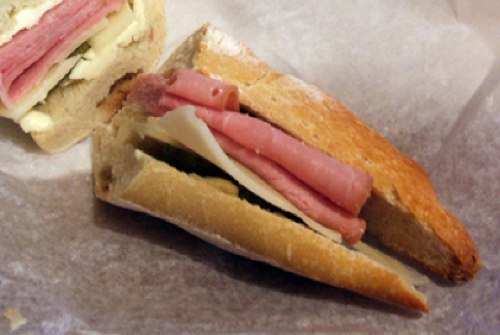
The second - a much heartier sandwich, more a meal rather than something to have with tea! The base for this is a good baguette sliced lengthways and completed with a simple quality filling. The filling is most likely to be ham, saucisson or cheese, possibly ham and cheese but not simply a long loaf stuffed with all the deli sandwich making ingredients possible!

Ham sandwich at La Baguette
image from Flickr


Size can vary, just as the baguette varies - the other day lunching on a merguez roll at a cafe, I watched as two leather clad bikers ripped into sandwiches the size and of an American Football. This worked quite well until a rather petit young woman was served the same sandwich and was reduced to gasping and pulling small mouthfuls off the bread.

The third - the quarter loaf which is two very thick slices of a white loaf filled with a meal often chips, processed meat and achaar. The quarter loaf in Gauteng is similar to the Gatsby in the Western Cape, both going back to the original intent of Lord Sandwich to provide an easy way to eat a meal.

An Enormous Gatsby Sandwich
image from a blog


The quarter loaf is a rough, ready and affordable way of eating a hearty meal with little finesse. A colleague even insisted, that when she was at school they placed quarter loaves under the wheels of parked cars about to drive off to get a compressed sandwich.


Thursday, July 28, 2011

iPhoneography in Montceau le Mines, Bourgogne.

I was in Montceau Le Mines yesterday without my point and shoot and got to thinking about some of the podcasts I had heard lately that were promoting the iPhone Camera as a device that could make good artistic images which could even be printed at reasonable size.

I therefore strolled around a bit and looked for some subjects that suited the camera specifications of my 3G iPhone.

Close up of a frog in garage door graffiti
photograph by ChigyTweeter
published under a Creative Commons Attribution-NonCommercial-ShareAlike license.


This was an ideal subject as it was on a garage door across the street so there were no focus issues and no light areas which would test the exposure range of the 3G - so its easy to look good.

To me this photos and those below, seem pretty good especially when comparing them to some of what I've come across online such as iPhoneography.com, iPhoneart.com, Jack Holingsworth and flickr-takenwithiphone.

Seems like one of two things happen that don't encourage good iPhonePhotos - photographers get too gimmicky, accept poorer quality or simply put a filter on a poor photo and think its arty!

Close up of a Motor Bike's controls in Montceau les Mines.
photograph by ChigyTweeter
published under a Creative Commons Attribution-NonCommercial-ShareAlike license.

 
Signs Silhouets Montceau Le Mines
photograph by ChigyTweeter
published under a Creative Commons Attribution-NonCommercial-ShareAlike license.


So what do you think of the iPhone photography movement? Contact me with your thoughts or comment below!

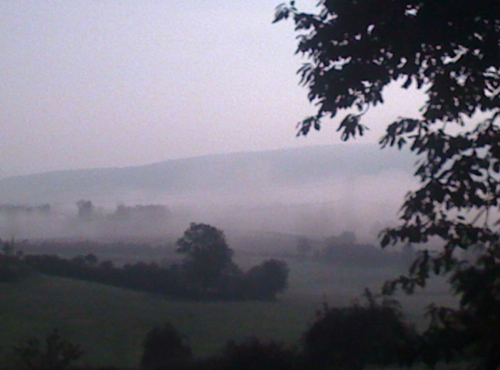
And the next morning back at the calm of The House at Le Gros Chigy.

Morning Mist in the Tranquility of Le Gros Chigy
photograph by ChigyTweeter
published under a Creative Commons Attribution-NonCommercial-ShareAlike license.


Saturday, July 23, 2011

Donkeys in a Downpour

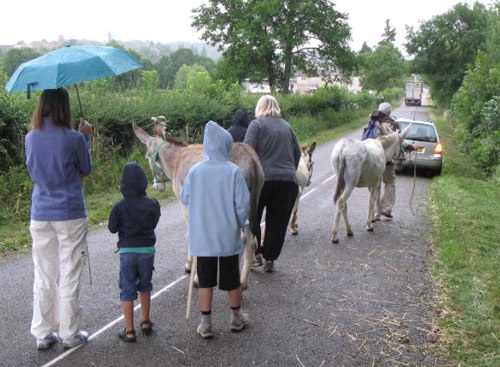
It seemed a pleasant enough task for a sunny Bourgogne day - moving three donkeys around a kilometer to a new pasture. All started well, although rain was threatening.

Moving Donkeys

However, no more than a few hundred meters into the move and the rain started


an got fairly hectic at times


The task was eventually accompolished and the soaked handlers were able to get in out of the rain, change clothes and eventually warm up!


Friday, June 24, 2011

French Bread 1 - Carbon Footprints & Global Warming Around The Bakery

The fact that "casser la croûte", which literally means break the crust, can mean such diverse things as have dinner, take a bite, have a snack, munch, grab a bite and eat indicates how central bread is to eating in France!

Bread is part of all French  meals
photograph by ChigyTweet
published under a Creative Commons Attribution-NonCommercial-ShareAlike license.


The Baguette is probably the most eaten bread in France and definitely the one anglophones think of as "French Bread". It is very different to the bread sliced bread most popular in anglophone countries, mainly as the crust is what one looks for in the baguette while its the part left in sliced bread.

There are lots of interesting things to talk about in baking and bread in France, some of which I will cover in later posts. This time I find it interesting to look at the environmental impact of bread and the way its bought.

Get up early in the morning, go to a bakery and see Frenchmen coming in to get bread for their breakfast - yesterdays bread is not fresh and crispy enough for a good tartine! If you are at a bakery in a village, its striking that many people drive to collect their bread.

What is interesting from a global waring viewpoint is how the carbon footprint of transporting the bread compares with that of making the bread.

Just for those not yet following this - it has been found that the average temperature worldwide has increased increasingly rapidly over the last 30 years - now known as Global Warming. This increase has been linked to the increased emissions of gasses such as Carbon Dioxide (CO₂) and Methane which contribute to the greenhouse effect of the atmosphere - therefore the name greenhouse gas. A continued increase in temperature threatens much including water levels, agriculture and desertification. There is therefore a focus on decreasing the emission of these gasses. CO₂ has become a kind of measuring stick for emissions with the quantity emitted being termed the carbon footprint.

Electric Bread Baking Oven
photograph by Sifu Renka
published under a Creative Commons Attribution-NonCommercial-ShareAlike license.


Making bread in the United Kingdom, has been calculated to release 1220 to 1555 grams of CO₂ per kilogram of bread. Its interesting that of this energy 41% comes from the production of raw materials, 19% from processing and 25% (at least in the UK) from refrigeration and toasting in the home. Since a baguette normally weighs 250 gram and is never frozen or toasted it will produce at most 292 grams of CO₂ in its manufacture.

The shortest distance I need to drive to get to the bakery for my baguette is 2,5 kilometers. Since my car produces 189 gram of CO₂ per kilometer travelled I will have emitted 945 gram CO2 - more than three times as much as the bread I buy.

This raises all sorts of thoughts and ideas - could bread be delivered in bulk to villages, could neighbours buy for each other, would frozen dough baked at home give an acceptable bread or should the French change their eating habits.

Wednesday, June 15, 2011

The Salornay sur Guye Marchés Aux Puces.

There seem to be many more effective channels of getting rid of old things one no longer wants in France than in South Africa.

In Paris days are set aside where unwanted furniture and appliances are put on the pavement to be removed by garbage removal after residents have had a chance to take what ever they might need! In Burgundy there is TROC, a chain of shops that specialises in removing and selling the contents of deceased estates. Then there are very active INTERNET sites that sell second hand goods as well as regular Garage Sales and Flea Markets in many towns and villages.

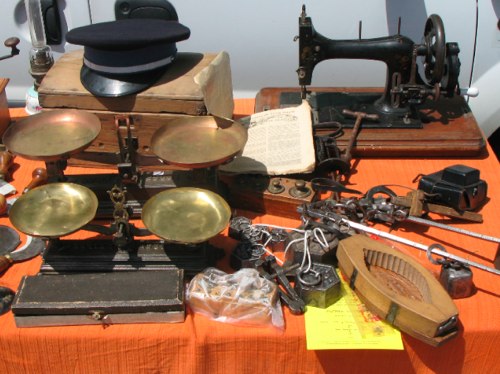
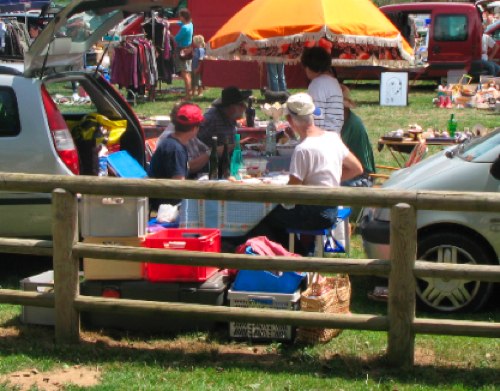
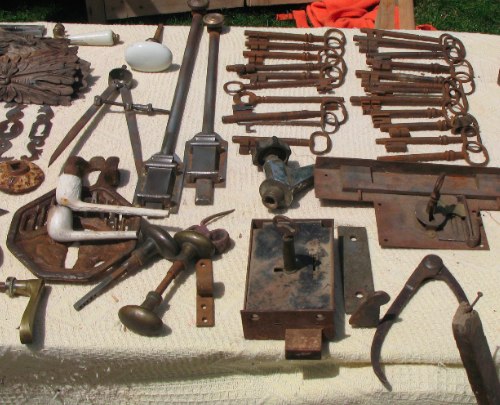
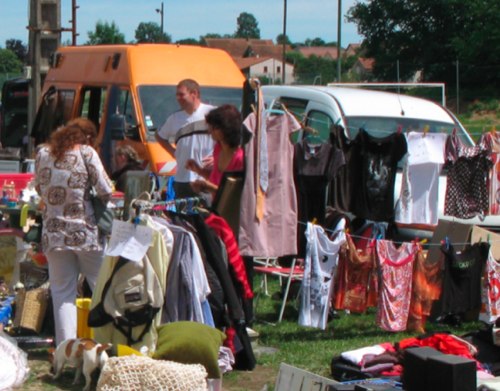
It was the turn of Salornay sur Guy to hold their Flea Market. One hundred stalls set out on the football field near the camping ground sold just about everything!

Scale sewing mahine hat
photograph by ChigyTweet
published under a Creative Commons Attribution-NonCommercial-ShareAlike license.

 
Books
photograph by ChigyTweet
published under a Creative Commons Attribution-NonCommercial-ShareAlike license.

 
Aperture
photograph by ChigyTweet
published under a Creative Commons Attribution-NonCommercial-ShareAlike license.

 
Locks Keys Pipes
photograph by ChigyTweet
published under a Creative Commons Attribution-NonCommercial-ShareAlike license.

 
Clothes
photograph by ChigyTweet
published under a Creative Commons Attribution-NonCommercial-ShareAlike license.

 
Everything
photograph by ChigyTweet
published under a Creative Commons Attribution-NonCommercial-ShareAlike license.


The food and drinks tent was an important part of an outing - selling buvette, tripes, pork chops, mergez from 06:30 to 19:00. For those sellers who this doesn't suit they simply set up a table near there stall and serve lunch!

Sellers Lunch at the marchés aux puces
photograph by ChigyTweet
published under a Creative Commons Attribution-NonCommercial-ShareAlike license.


Sunday, June 5, 2011

Magpie Trapping Near The House at Le Gros Chigy.

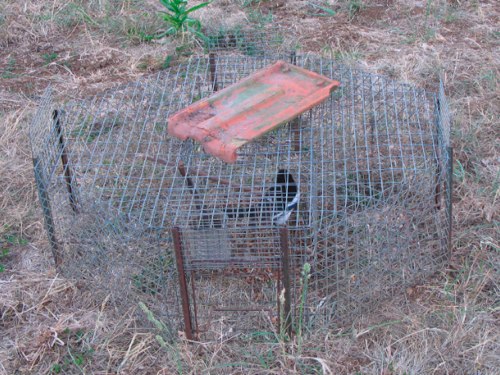
In a previous post I mentioned that the Magpie was one of the birds we had seen at Le Gros Chigy. I didn't know some of the issues around this bird, which are reflected by the contraption below that we came across in a field just past the House at Le Gros Chigy. I just thought Magpies were very clever birds that like shinny things!

Octogonal, four cage Magpie trap showing
photograph by ChigyTweet
published under a Creative Commons Attribution-NonCommercial-ShareAlike license.


This shows a trap which we found in a field. The Magpie is in the centre compartment and attracts others which enter through one of the four doors. They are trapped as the door is released behind them by the their weight on the floor of the segment. This kind of trap also works for crows.

The photo is pretty unclear, so there are separate photos of a Eurasian Magpie and a trap which give a bit more detail.

The Magpie is not found in South Africa, or the Southern Hemisphere for that matter, although its widespread in the Northern hemisphere. I was therefore not aware of the fact that it is mainly seen as a pest. For once the conservationists and the hunters seem to have the same view, because one of the Magpie's foods is young birds and eggs.

Picture of Magpie from Wikimedia Commons
published under a Creative Commons Attribution-NonCommercial-ShareAlike license.


The bird watchers accuse the Magpie of decimating garden birds by preying on the nests, decreasing the number of young birds reaching adulthood. In the UK there is still discussion on the real impact of this on populations, but the fact that the numbers of Magpies have grown steadily supports the hypothesis. Although a counter hypothesis is that Magpie numbers increased with the number of cars, as the amount of road kill improved the food supply!

The hunters are even more worried because the Magpie effects the number of live game birds available at the start of the hunting season. The 30 million live game birds released from breeding farms are not effected by the Magpies but the wild birds are especially during the nesting phase. This is a powerful lobby of influential people so its interesting to see that the Magpies seem to have the upper hand.

The farmers feel that their livelihoods are effected by the Magpie who are omnivores and also eat fruit and cereals.

Therefore there's quite a widespread movement to eliminate or at least control/reduce the number of Magpies.

Multi catch crow/magpie live trap
click image to visit site


In the United States the Magpie is protected as a migratory non game bird, but special conditions are in place allowing their elimination when they are found to be or about to be damaging agricultural outputs. In the UK complicated licensing and rules place constraints on the methods a trapper may use to trap Magpies. In France it appears that, so long as its your land, their are few restrictions.
The Magpies are normally attracted to the trap by placing suitable food or a live "bait bird " in the central compartment of the trap. In the case of the trap we saw the bait bird was very agitated and it didn't seem a very humane operation. One article I read, stated that it was not really inhumane as the bait bird was killed each time a bird was trapped, as the caught bird became the bait bird!

Thursday, June 2, 2011

Massy - Clunisois villages 3

Another village, although even smaller than St-André-le-Désert is Massy, between Salornay & Cluny, it boasts a beautiful early 11th Century church as well as a chateau.

Cluny tourisme webpage - Massy
click image to visit site