Showing posts with label farming. Show all posts

Saturday, April 5, 2014

Signs of Summer

Are these the first signs of the coming summer?

The fruit trees are blossoming!

The charolaise are out of the barns and back in the fields!

Then rape on the hill is turning yellow!

Dandilions flowering in the fields!


We are past the spring equinox and have had a very mild winter, so are hoping that there is not a cold snap before the summer as this would reverse these signs and damage the crops.

Tuesday, October 22, 2013

The Autumn (Fall) is Coming to Le Gros Chigy!

Since the autumn is showing its colours in Burgundy, I am going to post some of the photos I took back at the end of October 2010.

The first one is of a Charolais in a field on the Massey Salornay road, not far out of Salornay.

Carrolais in front of autumn colourd trees in Southern Burgundy
photograph by ChigyTweeter
published under a Creative Commons Attribution-NonCommercial-ShareAlike license.


Yes you do really get such bright and contrasty pictures and no it doesn't last for long because as you see the leaves are already falling.

The photo is a HDR composite using three photos taken with a Canon G7 at f3.5 for 1/80th.

Friday, February 8, 2013

Some More Produce Charts

For those who liked the fruit chart, here are two more of the Fresh Produce Charts that show when fresh vegetables and fresh herbs should be available.


This and other charts on vegetables and herbs are available online at Chasing Delicious, who apparently designed them and can also be bought at The Sweet Tooth Paper Goods Company.

Thursday, January 10, 2013

What Can We Expect on the Cluny Market and When?

As winter runs its course, it's nice to start thinking about all that fresh local fruit that will become available from friends and neighbors and the local markets. I found these interesting graphs on line.


I'm not knowledgable enough to know how well this applies to Le Gros Chigy, but its a nice picture to put in your kitchen anyway.

This and other charts on vegetables and herbs are available online at Chasing Delicious, who apparently designed them and can also be bought at The Sweet Tooth Paper Goods Company.
What about developing our own chart for Bourgogne or even a part thereof?

Sunday, June 24, 2012

Power Lines Do Effect Us or Do Power Lines effect Us?

Here is a nice view of the Bourgogne countryside from Joël's room. Of course there are the ever present Charolaise grazing on the hills.

Image by Gros Chigy is licensed under a Creative Commons Attribution-NonCommercial-ShareAlike 3.0 Unported License.

This sight got me to thinking about a study I had heard about on a podcast a few months ago, regarding the way cattle stand in fields.

Of course "they stand with their rears to the wind in a rainstorm" makes a lot of sense, otherwise things would be very uncomfortable. But this study was about the way cattle stand in circumstances that offer more freedom.

It was in 2008 that a German team of scientists claimed that they had found that herds of cattle tend to orientate themselves with the magnetic lines of the earth. Interestingly this was proven by comparing herds close to and well removed from overhead power lines. The reasoning being that the power lines would result in herds nearby not being able to orientate themselves to the earths magnetic lines because their sensing system would be disrupted by the magnetic field from the lines.

What I like most about this story is the innovative use of free information available in Google Earth.

There has been some discussion about the results with another team not being to replicate the results, but the original results, at least for now seem to remain valid!

At a casual glance the two herds in this photo seem to be orientated in a similar direction, although one is under a power lines. Of course two observations don't constitute proof! So I wonder If and how the power lines effect us?

Saturday, July 23, 2011

Donkeys in a Downpour

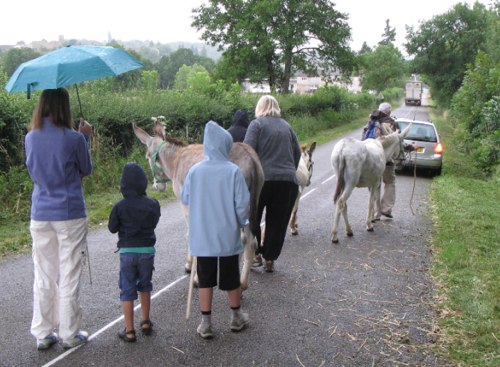
It seemed a pleasant enough task for a sunny Bourgogne day - moving three donkeys around a kilometer to a new pasture. All started well, although rain was threatening.

Moving Donkeys

However, no more than a few hundred meters into the move and the rain started


an got fairly hectic at times


The task was eventually accompolished and the soaked handlers were able to get in out of the rain, change clothes and eventually warm up!


Thursday, July 21, 2011

Colours at the Market

Being off line and using the iPad allowed me to play a bit with some of the interesting graphics programmes for Apple.

A combination of a number of shots of colourful vegetables at markets.
photographs and composite by ChigyTweet
published under a Creative Commons Attribution-NonCommercial-ShareAlike license.


This one was produced using the free SketchBook Express and simply copying clips into the applications layers.

Sunday, June 5, 2011

Magpie Trapping Near The House at Le Gros Chigy.

In a previous post I mentioned that the Magpie was one of the birds we had seen at Le Gros Chigy. I didn't know some of the issues around this bird, which are reflected by the contraption below that we came across in a field just past the House at Le Gros Chigy. I just thought Magpies were very clever birds that like shinny things!
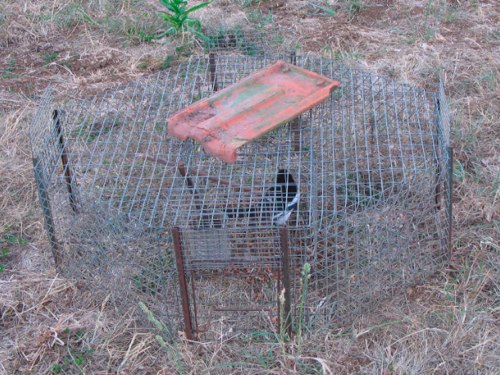
Octogonal, four cage Magpie trap showing
photograph by ChigyTweet
published under a Creative Commons Attribution-NonCommercial-ShareAlike license.


This shows a trap which we found in a field. The Magpie is in the centre compartment and attracts others which enter through one of the four doors. They are trapped as the door is released behind them by the their weight on the floor of the segment. This kind of trap also works for crows.

The photo is pretty unclear, so there are separate photos of a Eurasian Magpie and a trap which give a bit more detail.

The Magpie is not found in South Africa, or the Southern Hemisphere for that matter, although its widespread in the Northern hemisphere. I was therefore not aware of the fact that it is mainly seen as a pest. For once the conservationists and the hunters seem to have the same view, because one of the Magpie's foods is young birds and eggs.

Picture of Magpie from Wikimedia Commons
published under a Creative Commons Attribution-NonCommercial-ShareAlike license.


The bird watchers accuse the Magpie of decimating garden birds by preying on the nests, decreasing the number of young birds reaching adulthood. In the UK there is still discussion on the real impact of this on populations, but the fact that the numbers of Magpies have grown steadily supports the hypothesis. Although a counter hypothesis is that Magpie numbers increased with the number of cars, as the amount of road kill improved the food supply!

The hunters are even more worried because the Magpie effects the number of live game birds available at the start of the hunting season. The 30 million live game birds released from breeding farms are not effected by the Magpies but the wild birds are especially during the nesting phase. This is a powerful lobby of influential people so its interesting to see that the Magpies seem to have the upper hand.

The farmers feel that their livelihoods are effected by the Magpie who are omnivores and also eat fruit and cereals.

Therefore there's quite a widespread movement to eliminate or at least control/reduce the number of Magpies.

Multi catch crow/magpie live trap
click image to visit site


In the United States the Magpie is protected as a migratory non game bird, but special conditions are in place allowing their elimination when they are found to be or about to be damaging agricultural outputs. In the UK complicated licensing and rules place constraints on the methods a trapper may use to trap Magpies. In France it appears that, so long as its your land, their are few restrictions.

The Magpies are normally attracted to the trap by placing suitable food or a live "bait bird " in the central compartment of the trap. In the case of the trap we saw the bait bird was very agitated and it didn't seem a very humane operation. One article I read, stated that it was not really inhumane as the bait bird was killed each time a bird was trapped, as the caught bird became the bait bird!

Wednesday, October 27, 2010

Charolaise Beef Cattle From Around Le Gros Chigy.

I crossed paths with Charolais cattle a few times today. The first was early in the morning as I drove to buy bread and dropped from the 312 m altitude of The House at Le Gros Chigy to the 239 m of the Salornay Saint Andre la Desert road. The temperature plunged from what must have been around freezing at Le Gros Chigy to a heavy frost along the road that runs along the river.

It was a case of white cows on the white grass!

White Charolais cattle on a frost covered white field early in the morning near Le Gros Chigy.
photo by ChigyTweet
(Creative Commons Some Limitations License)


The Charolais are very much part of the rural scenery, dotting the green fields with their brilliant white, broken only by the dark patches on the rump. They are a world renowned breed of beef cattle that originated in Charolais, around Charolles which is just 25 km away from The House at Le Gros Chigy to the west.

As the weather gets colder its my understanding that the cattle are housed in barns.

iPhoto-2.jpg
photo by ChigyTweet
(Creative Commons Some Limitations License)


This one has it entrance decorated with the awards this farm's herd has won over the years at agricultural shows.

Later in the day and higher up the hill (near Le Bourg-Rameau at 329 m high) the weather was fine and warm leaving 8718 with a somewhat more relaxed and inquisitive view on things!

iPhoto-3.jpg
photo by ChigyTweet
(Creative Commons Some Limitations License)


I do notice that some of the farms are starting to cross the Charolaise with darker cattle, some that look very much like Jerseys but that doesn't seem to make much sense. Anyway my thought is will these iconic white cattle on bright green pastures become a less common site in Bourgogne?