Showing posts with label Neraby Villages. Show all posts

Friday, March 28, 2014

Watercolours in Burgundy

I have just got a new camera which really ups the potential I have to take better photographs. At the same time I've found a technique that allows the photographer to become a painter.

The St Catherine's bridge in Salornay su Guye takes on another look with a touch of watercolours, as does the main steeple of the Cluny Abbey.

Both these images are based on photographs taken by ChigyTweet and are available. Six megapixel versions of these files, which should make good prints are available by email on request.


Saturday, July 20, 2013

Things To Do In The Clunisois Area

The image below is from a map showing Cluny and surroundings, which can be found on the Cluny Tourism Information Office website. The darker brown area which we call the Clunisois Area (Communauté de communes du Clunisois) offers a range of attractions centered on Cluny a major religious centre of the Middle Ages.

Click Image to Download Complete Map

The map shows the villages within a short distance of The House at Le Gros Chigy that have interesting buildings and facilities although the keys to these is not on this extract. Click the map to access the full PDF document with the key.

Although even the church and grounds of a little village church like Massey are interesting, Cluny, Brancion, Cormatin and St Hippolyte are better known and offer more to the visitor.

The map is well worth downloading or getting a copy of as it holds much useful information.

Sunday, July 14, 2013

Les 5 villages, 3 mars 2013

Have a look at the photos and comments in this post by Poirier Bouchot who walked a 20 km route from Salornay passing through Gros Chigy, le Bourg Rameau, Chevagny sur Guye, Passy and Chérizet.

This post on the Nos randos et balades site has photos of Le Gros Chigy
from: Nos rondos et balades
(click image for full story online)

Friday, December 7, 2012

How Small Is Le Gros Chigy?

Its not exactly easy to answer this, because Le Gros Chigy is part of the St Andre le Desert Commune. It is at the level of the commune that information is collected by the census. I did post on the administrative and geographic structure of Le Gros Chigy and the area early on.

Map showing the St Andre le Desert commune boudaries
from: GEOPORTAIL
(click image for information)


The data for St Andre le Desert is available online and shows that St Andre has a total population of 261 in 2009 , which is confirmed by one of the neighbors who sits on the commune council. This makes it the 24,072nd biggest entity in France.

Given that there are three "hamlets" within the commune (St Andre, Le Gros Chigy and le Bourg Rameau) and a few other concentrations of houses like Mazilly & St Michael its safe to assume there are less than 80 inhabitants in Le Gros Chigy itself.

Of interest to us as a non permanent resident is the number of houses, in 2007 there were 244 houses in St Andre le Desert of which only 127 where permanently occupied. The change over the years is show in the graph below.

Graph of the change in house occupation in Le Gros Chigy
from: map-france.com
(click image for information)


Thats enough for now, but other things appear as you scratch through the information.

Saturday, July 23, 2011

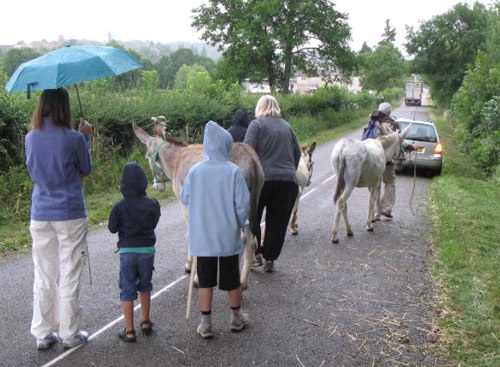
Donkeys in a Downpour

It seemed a pleasant enough task for a sunny Bourgogne day - moving three donkeys around a kilometer to a new pasture. All started well, although rain was threatening.

Moving Donkeys

However, no more than a few hundred meters into the move and the rain started


an got fairly hectic at times


The task was eventually accompolished and the soaked handlers were able to get in out of the rain, change clothes and eventually warm up!


Sunday, July 3, 2011

Musicians at the Fête Médiévales de Mont-Saint-Vincent

The main attraction at the Fête was probably the fighting of the knights, but I am going to have a look at some of the musicians who were performing there. For more on the knights have a look at the article in Le Journal se Soane-et-Loire.

Our first stop at the Faire was a group playing close to the entrance with some interesting instruments.

Aperture
photograph by ChigyTweet
published under a Creative Commons Attribution-NonCommercial-ShareAlike license.


The group was expanded with more players during the day and entertained continually.


Another pair of musicians walked the streets singing traditional folk songs and entertaining the younger visitors with this interesting form of puppets!


Just for the record here's a photo of the knights lined up at the start of the jousting!

Knights lined up before the jousting
photograph by ChigyTweet
published under a Creative Commons Attribution-NonCommercial-ShareAlike license.


Wednesday, June 15, 2011

The Salornay sur Guye Marchés Aux Puces.

There seem to be many more effective channels of getting rid of old things one no longer wants in France than in South Africa.

In Paris days are set aside where unwanted furniture and appliances are put on the pavement to be removed by garbage removal after residents have had a chance to take what ever they might need! In Burgundy there is TROC, a chain of shops that specialises in removing and selling the contents of deceased estates. Then there are very active INTERNET sites that sell second hand goods as well as regular Garage Sales and Flea Markets in many towns and villages.

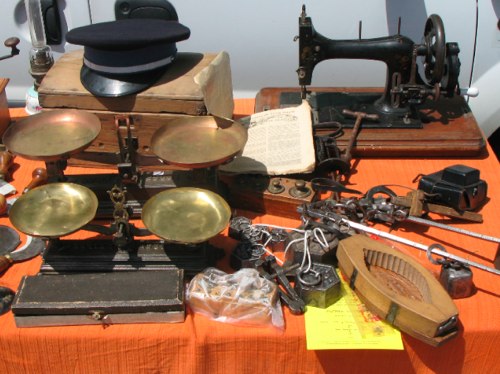
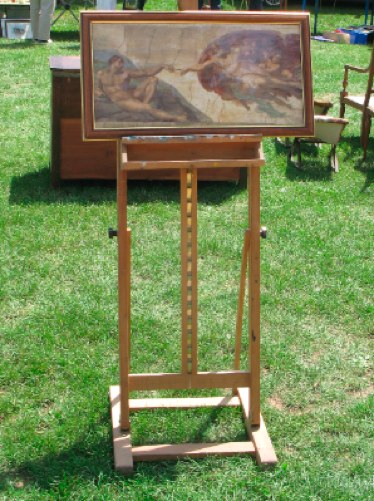
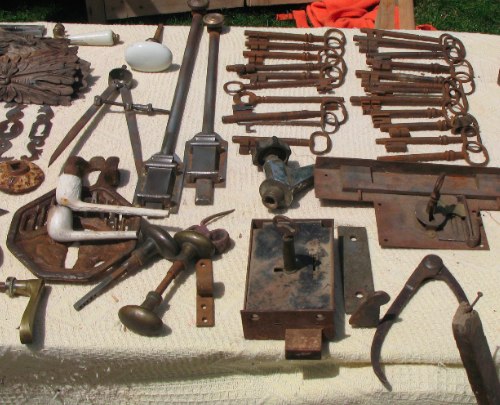
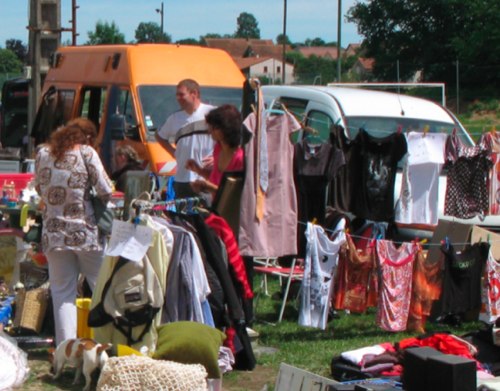
It was the turn of Salornay sur Guy to hold their Flea Market. One hundred stalls set out on the football field near the camping ground sold just about everything!

Scale sewing mahine hat
photograph by ChigyTweet
published under a Creative Commons Attribution-NonCommercial-ShareAlike license.

 
Books
photograph by ChigyTweet
published under a Creative Commons Attribution-NonCommercial-ShareAlike license.

 
Aperture
photograph by ChigyTweet
published under a Creative Commons Attribution-NonCommercial-ShareAlike license.

 
Locks Keys Pipes
photograph by ChigyTweet
published under a Creative Commons Attribution-NonCommercial-ShareAlike license.

 
Clothes
photograph by ChigyTweet
published under a Creative Commons Attribution-NonCommercial-ShareAlike license.

 
Everything
photograph by ChigyTweet
published under a Creative Commons Attribution-NonCommercial-ShareAlike license.


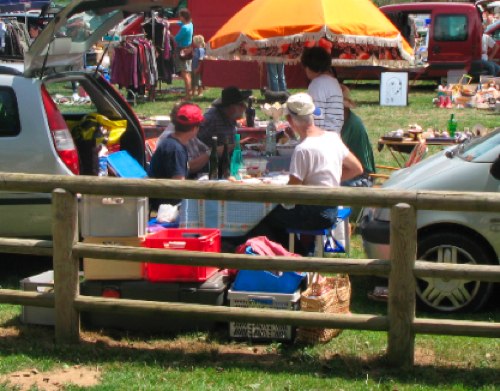
The food and drinks tent was an important part of an outing - selling buvette, tripes, pork chops, mergez from 06:30 to 19:00. For those sellers who this doesn't suit they simply set up a table near there stall and serve lunch!

Sellers Lunch at the marchés aux puces
photograph by ChigyTweet
published under a Creative Commons Attribution-NonCommercial-ShareAlike license.


Friday, June 10, 2011

Narrow Roads & Streets

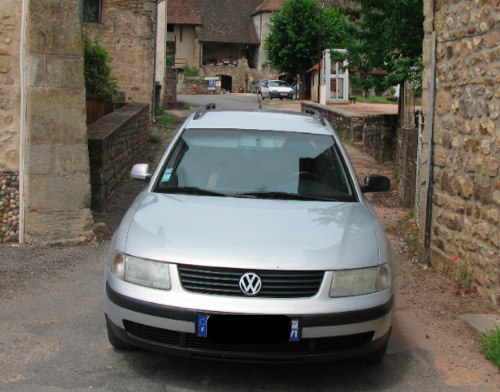
Coming back to The House at Le Gros Chigy yesterday afternoon we came across this in the road.

Farm trafic on a narrow rural road.
photograph by ChigyTweet
published under a Creative Commons Attribution-NonCommercial-ShareAlike license.


With a bit of maneuvering onto the grass we managed to pass each other and continue on our ways.

It did get me to thinking about the difficulties of driving on French rural roads, especially while focussing on driving on the right hand side. As one moves off the motorways onto the as and progressively less important roads they get narrower and narrower

kwintessential defines the roads as:
Autoroutes, are highways with many lanes and a divider. Most highways require you to pay a toll to drive on them. Autoroutes in France are given the designation A and are marked by blue road signs showing a divided highway. These open roads in France are designed for long distance high speed inter city driving in France and many of them have petrol stations and rest areas with restaurants on the way.

Routes Nationals: These open roads in France are given the designation N and are well signposted main highways equipped with reflectors to aid night driving.

Routes Departmentales: These are secondary and tertiary local roads which begin with a D. They are smaller and not suitable for open road high speed driving over long distances.

Routes Communales: These are minor rural roads, not designed for high speed driving, although the fact that there are very few cars on them means that high speed driving, while illegal, may be possible. These roads begin with a C and are maintained by local communes who are the local government authorities in France.


Many roads are of a width that both cars need to have their left wheels just on the edge of the tarred surface or just off. This means what normally happens is when you see a car you slow down and edge apart. However, there are always those who are in a rush and you tend to meet on the corner - this is rather worrying for someone battling to find their position on a narrow road.

Then there are the really narrow roads where there is only tar for one car and the verge to the hedge or wall is so small that you have to find a place to pull off, allow the other car to pass and then continue.

This is even more the norm in villages where buildings right on the road or parked cars reduce the road to a single lane.

Narrow village streets cause vehicles to stop and wait
photograph by ChigyTweet
published under a Creative Commons Attribution-NonCommercial-ShareAlike license.

Thursday, June 2, 2011

Massy - Clunisois villages 3

Another village, although even smaller than St-André-le-Désert is Massy, between Salornay & Cluny, it boasts a beautiful early 11th Century church as well as a chateau.

Cluny tourisme webpage - Massy
click image to visit site


Monday, May 30, 2011

Cluny Market

You know you are not in SA anymore when you go to a rural French market on Saturday morning for your food, nursery and decor shopping.

View down one of the allies at the Cluny Saterday market.
photograph by ChigyTweet
published under a Creative Commons Attribution-NonCommercial-ShareAlike license.


I posted on the Saint Gengoux market once before and noted some of the markets in the area. http://www.frenchmarketdays.com has a summary of the markets in the area, but even this is not complete as it doesn't show the Buffiers market and probably many others in smaller villages.

What caught my photographic eye at the market were the colourful fruit and vegetables displays along with the chalked in prices on small blackboards. It was clear, looking around, that unlike streetside markets in South Africa, the prices differ between stalls.

Tomato Price at Cluny Saterday Market
photograph by ChigyTweet
published under a Creative Commons Attribution-NonCommercial-ShareAlike license.
Another Tomato Price
photograph by ChigyTweet
published under a Creative Commons Attribution-NonCommercial-ShareAlike license.


One might be tempted to think that a market in a small rural town would be selling only local food. However, although the providence of all food seems to be indicated, there is still food from all over the world.

Tropical Fruit from abroard and Pears from England on Cluny Saterday Market
photograph by ChigyTweet
published under a Creative Commons Attribution-NonCommercial-ShareAlike license.

Wednesday, May 18, 2011

Thinking About What To Do When We Arrive - Clunisois villages 1

Now that our return is approaching, I am starting to think about what to do and maybe what photographic theme to attack when we get back to The House at Le Gros Chigy. A good place to start is the small Clunisois villages in the area. I am going to be publishing single screen clips of the villages, maybe with a sentence or two, over the next while.

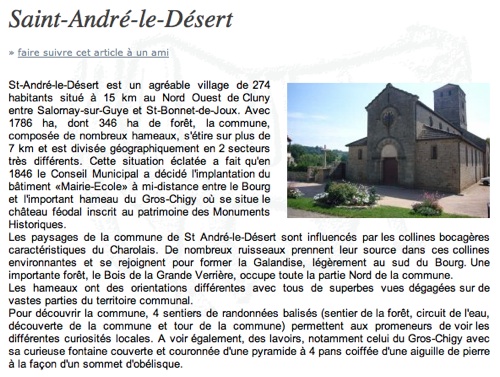
Obviously the place to start is St-André-le-Désert the "capital" of our commune.

A screenshot from the villages du Clunisois website.
click image to visit site


Saturday, October 30, 2010

Musing on Monuments

I have often wondered about the monuments which are to be found all around the area, and thought they were World War linked. But there seem to be two classes of crosses with lots of different origins.

Town Monuments


Every town or village seems to have a central monument erected to recognise the dead of the two world wars. In fact Salornay sur Guy has two monuments honouring First World War victims.
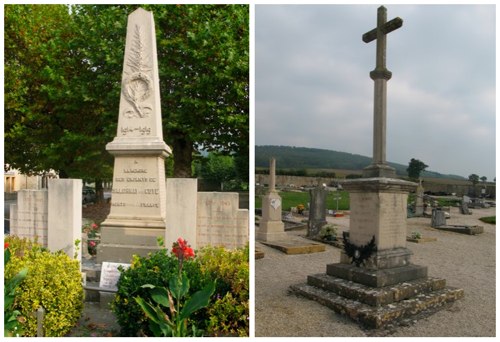
Two first worldwar monuments in Salornay sur Guye
photo by ChigyTweet
(Creative Commons Some Limitations License)


That on the left is in the town square and has the names of the casualties of the second world war recorded on the tombstones to the left and right on the central monument. The monument at the cemetery has all the names listed on the monument in the town but there are several that are not in the names in the cemetery - maybe there's a story in that?

More interesting to me is the nearby grave next to the monument in the cemetery of one of the people recorded, on the two monuments. The monuments record Claude Petits as having died on 12 October 1908. While his gravestone

System.jpg
photo by ChigyTweet
(Creative Commons Some Limitations License)


records his death on 20 October 1918 "for France". The explanation that maybe it was another person with the same first and family names is very unlikely and in any case the Claude Petit buried in the cemetery, should anyway have appeared on the monuments because he died "for France".

So there is another question, I like to see this as a shortsighted, hassled stone mason making a mistake and not being willing to correct it.

Roadside Monuments


I had thought that all the other monuments alongside roads were also linked to the World Wars which were obviously a very hard time for the rural population of France and wondered about the background stories. This conjured up pictures of night time ambushes, parachute drops and sabotage which made me think of the possibility of some kind of book explaining the times through the monuments! So on this visit I resolved to start having a look at the monuments I came across!

Here are the first three roadside crosses I documented.

A collage of the first tyhree roadside crosses documented in the Surrounding of Le Gros Chigy
photo by ChigyTweet
(Creative Commons Some Limitations License)


That might be a start, but not much progress! Two of them clearly have nothing to do with the World Wars as they are dated 1958 & 1851, while the third has no markings. So maybe next would be to extract the GPS co-ordinates form iPhone photos and see if that correlates to anything.

Anyway the collecting photographs and co-ordinates is a pleasure and its all very interesting, so I will continue and see what develops. Watch this blog for more monuments,

Monday, September 13, 2010

Nearby Villages - Salornay sur Guye

As a result of family connections Salornay was one of the first villages in France that I came to know, many years ago. It has not changed that much since then although it has smartened up and gained some extra facilitates - it did lose its patisserie which used to sell delicious "barquette au chocolat".

Salornay_Main_Street.jpg
Photo by ChigyTweet published under a CC license.


Salornay, only 4 km from Le Gros Chigy, is the nearest town with a range of facilities which includes hotel, camping ground, bar, bakeries, green grocer, butchery, supermarket, tabac, post office, service station, hairdresser, electrical, builder, old age home, hospital, primary school, library etc. It has a population of around 800 which appears to be increasing slowly.

_The House at Le Gros Chigy_ to _Salornay-sur-Guye_ - Google Maps.jpg
Photo by ChigyTweet published under a CC license.


Close by Cluny (16.5 km from La Gros Chigy) and Cormatin at 14 km have a much wider variety of facilities as well as their tourist attractions while Macon and Montceau-les-Mines are large cities 30 to 40 kilometers away.

Central to the village is a square housing a war memorial,

Salornay_War_Memorial-2.jpg
Photo by ChigyTweet published under a CC license.


tourist maps and a gravel pentanque area 1 400 M2 area surrounded by trees. This is also where the produce market is held on the 2nd and 4th Thurdays of the month.

Salornay_Market.jpg
Photo by ChigyTweet published under a CC license.


The Guy river flows through the village just to the East of the square where it is crossed by the medievel Sainte Catherine bridge.

The Gande river flows to the West of the Village, joining the Guye to the North. With two rivers not not surprising to find six lavoir (community washing places although lavoir translates to washhouse this by no means captures their social function in the past), five bridges and the remains of mills.

A Church with Romanesque bell tower and apse

SalornayChurch-1.jpg
Photo by ChigyTweet published under a CC license.


along with a private XVc chateau

SalornayChateau.jpg
Photo by ChigyTweet published under a CC license.


complete a picturesque village, whose character has not been lost to modernisation which has resulted in more new houses and plastering of old stone houses than is really desirable.