Showing posts with label house. Show all posts

Monday, June 3, 2013

New Colours at The House at Le Gros Chigy

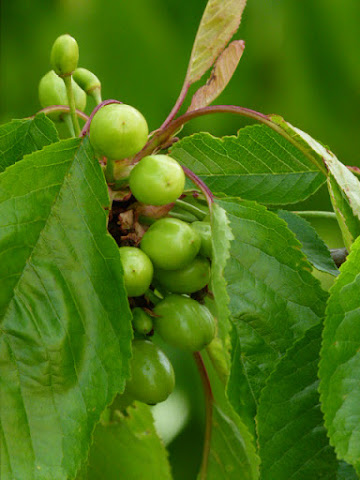
The House at Le Gros Chigy is opening up for the "summer", although its not very summery yet and the weather seems to have destroyed the cherry crop for the second year in a row.

photograph by Dominique
published under a Creative Commons license.


Friday, December 7, 2012

How Small Is Le Gros Chigy?

Its not exactly easy to answer this, because Le Gros Chigy is part of the St Andre le Desert Commune. It is at the level of the commune that information is collected by the census. I did post on the administrative and geographic structure of Le Gros Chigy and the area early on.

Map showing the St Andre le Desert commune boudaries
from: GEOPORTAIL
(click image for information)


The data for St Andre le Desert is available online and shows that St Andre has a total population of 261 in 2009 , which is confirmed by one of the neighbors who sits on the commune council. This makes it the 24,072nd biggest entity in France.

Given that there are three "hamlets" within the commune (St Andre, Le Gros Chigy and le Bourg Rameau) and a few other concentrations of houses like Mazilly & St Michael its safe to assume there are less than 80 inhabitants in Le Gros Chigy itself.

Of interest to us as a non permanent resident is the number of houses, in 2007 there were 244 houses in St Andre le Desert of which only 127 where permanently occupied. The change over the years is show in the graph below.

Graph of the change in house occupation in Le Gros Chigy
from: map-france.com
(click image for information)


Thats enough for now, but other things appear as you scratch through the information.

Thursday, November 29, 2012

Le Gros Chigy's Nonexistent Road On GOOGLE Earth

A few days ago, a group of scientists busy in the South Sea Island area, visited the co-ordinates where GOOGLE Earth shows Sandy Island. They were intrigued that the island did not appear on their navigation charts and is blacked out on GOOGLE World and other online maps. What they found was not a newly formed volcanic island but NOTHING.

Webshot showing the apparently new Pacific island
click image to visit site


Now we have a nonexistent road at Le Gros Chigy

Nonexistant road just past The House At Le Gros Chigy

While this is a throughway for the walker its not even suited to cycling except by the real cross country specialist and is too small for a 4X4. Google Maps shows it as the same size road as that in front of the house, so its not just illustrative. On top of that it gets a unique name! which not all roads in Le Gros Chigy do.

Monday, November 26, 2012

Toilet and Bathroom Finished Off With Novel Skirtings

When it came to buying skirting boards we were not impressed by the availability or cost of skirting boards. Luckily we came across these decorative pressings on a sale and with a pot of paint I think we have an interesting and attractive result.

The elephants in the jungle of the toilet - we still wonder whether to paint the down pipe as a tree trunk or to try and blend it in with thee wall!

The redecorated toilet at The House At Le Gros Chigy
photograph by GrosChigy
published under a Creative Commons Attribution-NonCommercial-ShareAlike license.


Jungle pressing in The House At Le Gros Chigy toilet
photograph by ChigyTweet
published under a Creative Commons Attribution-NonCommercial-ShareAlike license.


The waves in the bathroom reflecting the running water.


Waves in the bathroom.
photograph by GrosChigy
published under a Creative Commons Attribution-NonCommercial-ShareAlike license.

Thursday, September 6, 2012

The Redecorated Kitchen

The kitchen has been wallpapered, painted and "new" kitchen furniture installed.

The action corner of the redeccorated kitchen.
photograph by ChigyTweet
published under a Creative Commons Attribution-NonCommercial-ShareAlike license.


I call the furniture new, because it is old kitchen units from a family members previous kitchen that we have re organized, painted and installed more or less in the same way as the original kitchen.

The colour is green, reflecting the leaves in the wallpaper and the country side and contrasting strongly with the main bedroom that leads off the kitchen.

Thanks to all those who helped redoing the kitchen.

Saturday, May 19, 2012

The Partridge and Cherries are Back at The House at Le Gros Chigy

Seeing the green cherries on the trees and the partridges on the wall says that it's time we were back at The House at Le Gros Chigy!

photograph by Joël
published under a Creative Commons license

photograph by Joël
published under a Creative Commons license

We fly in around two weeks - the moss on the wall the partridge is sitting on is possibly one of the first jobs I will have to attack.

Saturday, February 11, 2012

The House at Le Gros Chigy in the Snow

 For too long the site has been showing a photograph of a tropical looking waterfall. Now thanks to a neighbour here is a more representative winter picture.

 All rights served.

Wednesday, September 28, 2011

More Colours That Reflect The Surroundings

The flowers that have grown spontaneously next to the Grange seem to be reflected in the colours we chose for what is known as Joël's Room .

Crocusses 1
photograph by ChigyTweeter
published under a Creative Commons Attribution-NonCommercial-ShareAlike license.


This is the second, downstairs bedroom just opposite the bathroom.

JoelsRoom 2
photograph by ChigyTweeter
published under a Creative Commons Attribution-NonCommercial-ShareAlike license.


The stone wall was revealed by four or five days of chipping away at the wall, which was plastered and wallpapered as shown in the "before picture" below.

Joels room at The House at Le Gros Chigy before renovatin
photograph by ChigyTweeter
published under a Creative Commons Attribution-NonCommercial-ShareAlike license.

Taking in Fuel For The Winter

This is something foreign to a South African!

The House at La Gros Chigy is centrally heated with a fuel oil burning system that also supplies hot water to the house and now was the time to take on the oil necessary to last until we return. Getting the fuel to the tank was easy.

FuelTransfer
photograph by ChigyTweeter
published under a Creative Commons Attribution-NonCommercial-ShareAlike license.


The two more difficult things were getting the right amount of fuel into the tank and getting the tanker back on its rounds.

Having no idea how much fuel we had used I went to measure the tank and calculate the consumption from the level readings I had taken. BUt this was no simple cylindrical tank, but a design with two rectangular tanks connected by three vertical much smaller tanks. According to the fuel man this was a design that ensured the strength of the tank but made its volume "incalculable".

So we filled 1000l into the tank in 200 l batches and measured the depth reading on the meter. These readings and some fiddling with a spreadsheet should allowe me to get a rough idea of the size of the tank and our the consumption since we first took in fuel.

The difficulty in getting the tanker back on its route was simpler and only about squeezing out to the St Andre road.

TankerSqueezing
photograph by ChigyTweeter
published under a Creative Commons Attribution-NonCommercial-ShareAlike license.


Having worked for a community group trying to maintain the high standards that control building in our suburb, I find this picture interesting. In our suburb all roads have a 2m sidewalk between the road and the property boundary. Then each property has a limit of some meters (1.5 to 7) on how close they can build to this boundary. Here we have two buildings built right up to the road.

The difference of course is the epoch in which the buildings in the picture were built. It was before cars, let alone fuel tankers! Also the original buildings were farm houses grouped into a community rather than a planned urban development.

Sunday, September 11, 2011

Colours in the Redecoration of The House at Le Gros Chigy

One of the reasons that I have been rather slow in posting since we have been in France this time, is that we have been hard at work developing The House at Le Gros Chigy. Part of that has been redecorating existing and modified rooms in new and amazing colours.

Here is a first example:

A shot of the new bathroom upstairs at Le Gros Chigy.
photograph by ChigyTweeter
published under a Creative Commons Attribution-NonCommercial-ShareAlike license.


The obvious question is "how did you come up with this dark colour" as the basis for the decoration of the bathroom. The answer maybe lies outside and is almost visible through the window in this photo.

White cattle on green grass from The House at Le Gros Chigy
photograph by ChigyTweeter
published under a Creative Commons Attribution-NonCommercial-ShareAlike license.


This shot from the lounge window is clearer - the colour we chose for the bathroom is probably inspired by the colours of the countryside! To take it further and say the white cows against the green grass is reflected by the white bath against the green walls is probably pushing to to far, but some of the other colours we have used, which I will be posting about in the next while, also seem to have links to the countryside.

Sunday, August 28, 2011

Business Premises in Montceaux les Mines

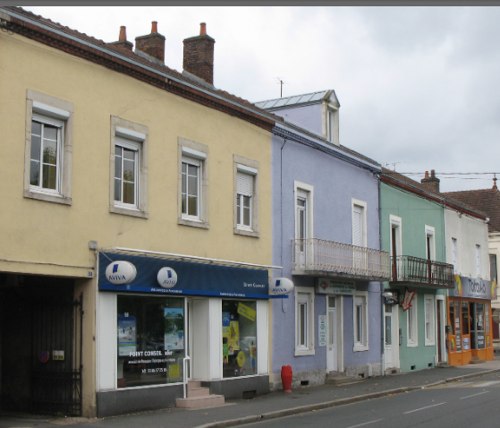
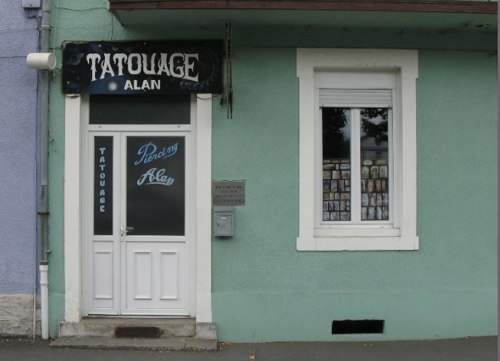
Waiting on some others doing business in the city centre the other day, I was struck by this row of businesses in what I suspect had been houses serving the factories along the canal.

Montceau Shops alongside the canal parking area near the city centre
photograph by ChigyTweeter
published under a Creative Commons Attribution-NonCommercial-ShareAlike license.


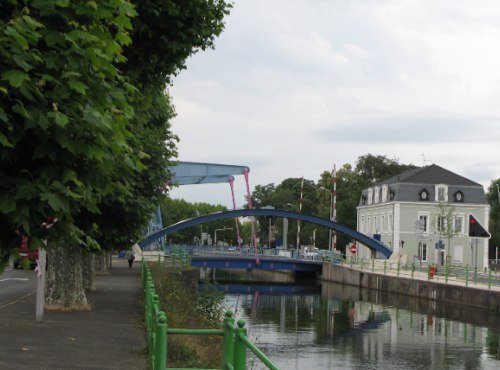
Besides being very different to shops near the city centre in South Africa the variety of colors and the different ways in which buildings are used makes the row attractive. The trees lining the parking across the street add to the pleasantness.

Tree Lined Streets along the streets in
photograph by ChigyTweeter
published under a Creative Commons Attribution-NonCommercial-ShareAlike license.


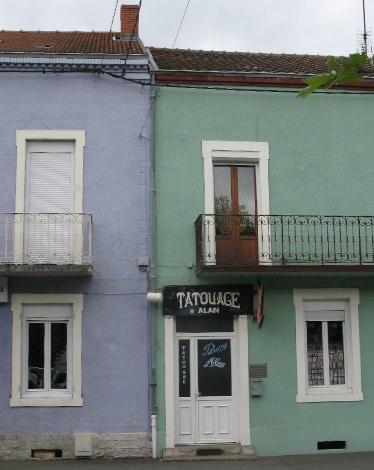
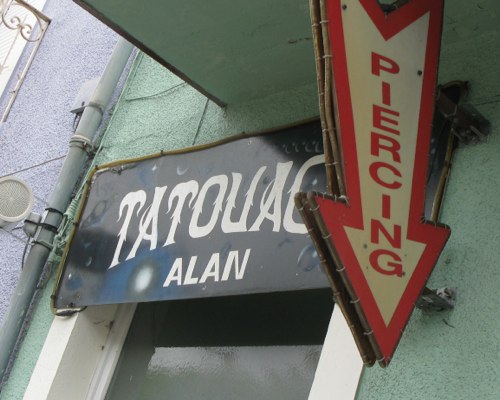
The third building in the row was particularly interesting and is the subject of the next few photos. By the way I can see my posts are becoming more and more image based - what do you think? is there something else you would prefer? For example more on the development of the house or on information appropriate to holidaying in the area?

A Tatoo Shop in the row of shops in Montceau
 
Entrance to a Tatoo Shop in the row of shops in Montceau
 
Multi Tasking Tatoo Shop in the row of shops in Montceau
 
photographs by ChigyTweeter
published under a Creative Commons Attribution-NonCommercial-ShareAlike license.

Wednesday, August 17, 2011

Flea Markets and Boot Sales - Puces et Vide Grenier

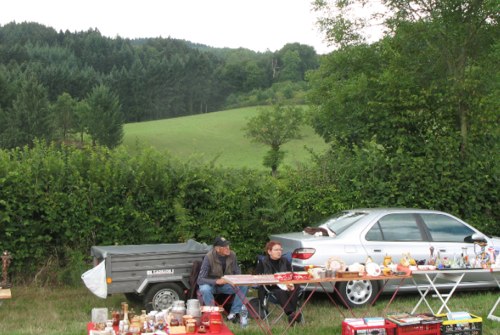
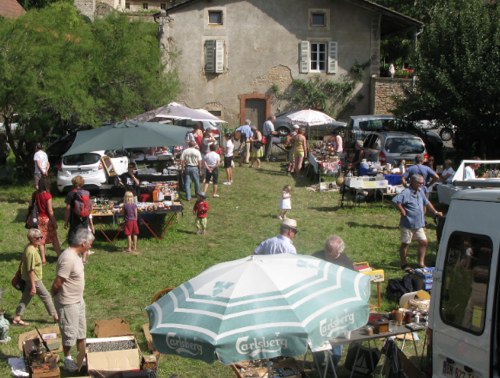
I am becoming a bit of an expert on Flea Markets and Boot Sales (Puces et Vide Grenier) here in Bourgogne!

The Vide Grenier at Sivignon was out in the fields on 14th July.

Aperture

Paying 31/07 The one at Blanot was on a field in the town. This allowed them to charge an entrance fee which made them unpopular with buyers and sellers alike.

In Village With an Entry Fee!

The Puces / Vide Grenier at Lounand ran from a few houses on the right into the road!

The Lounand Puces / Vide Grenier

Sunday, June 5, 2011

Magpie Trapping Near The House at Le Gros Chigy.

In a previous post I mentioned that the Magpie was one of the birds we had seen at Le Gros Chigy. I didn't know some of the issues around this bird, which are reflected by the contraption below that we came across in a field just past the House at Le Gros Chigy. I just thought Magpies were very clever birds that like shinny things!
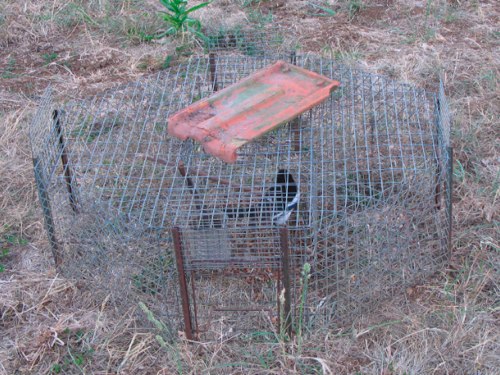
Octogonal, four cage Magpie trap showing
photograph by ChigyTweet
published under a Creative Commons Attribution-NonCommercial-ShareAlike license.


This shows a trap which we found in a field. The Magpie is in the centre compartment and attracts others which enter through one of the four doors. They are trapped as the door is released behind them by the their weight on the floor of the segment. This kind of trap also works for crows.

The photo is pretty unclear, so there are separate photos of a Eurasian Magpie and a trap which give a bit more detail.

The Magpie is not found in South Africa, or the Southern Hemisphere for that matter, although its widespread in the Northern hemisphere. I was therefore not aware of the fact that it is mainly seen as a pest. For once the conservationists and the hunters seem to have the same view, because one of the Magpie's foods is young birds and eggs.

Picture of Magpie from Wikimedia Commons
published under a Creative Commons Attribution-NonCommercial-ShareAlike license.


The bird watchers accuse the Magpie of decimating garden birds by preying on the nests, decreasing the number of young birds reaching adulthood. In the UK there is still discussion on the real impact of this on populations, but the fact that the numbers of Magpies have grown steadily supports the hypothesis. Although a counter hypothesis is that Magpie numbers increased with the number of cars, as the amount of road kill improved the food supply!

The hunters are even more worried because the Magpie effects the number of live game birds available at the start of the hunting season. The 30 million live game birds released from breeding farms are not effected by the Magpies but the wild birds are especially during the nesting phase. This is a powerful lobby of influential people so its interesting to see that the Magpies seem to have the upper hand.

The farmers feel that their livelihoods are effected by the Magpie who are omnivores and also eat fruit and cereals.

Therefore there's quite a widespread movement to eliminate or at least control/reduce the number of Magpies.

Multi catch crow/magpie live trap
click image to visit site


In the United States the Magpie is protected as a migratory non game bird, but special conditions are in place allowing their elimination when they are found to be or about to be damaging agricultural outputs. In the UK complicated licensing and rules place constraints on the methods a trapper may use to trap Magpies. In France it appears that, so long as its your land, their are few restrictions.

The Magpies are normally attracted to the trap by placing suitable food or a live "bait bird " in the central compartment of the trap. In the case of the trap we saw the bait bird was very agitated and it didn't seem a very humane operation. One article I read, stated that it was not really inhumane as the bait bird was killed each time a bird was trapped, as the caught bird became the bait bird!

Tuesday, May 24, 2011

Where In The World Are We?

From the rough and tumble of an African international airport

The Rough and Tumble of an African Airport
photograph by ChigyTweet
published under a Creative Commons Attribution-NonCommercial-ShareAlike license.


To the more sanitised and less hectic European airport

A more sanitised and less hectic Europoean Airport
photograph by ChigyTweet
published under a Creative Commons Attribution-NonCommercial-ShareAlike license.


To an iconic 122 year old manmade tourist attraction

To an iconic 122 year old manmade tourist attraction
photograph by ChigyTweet
published under a Creative Commons Attribution-NonCommercial-ShareAlike license.


WE ARE ON OUR WAY TO THE HOUSE AT LE GROS CHIGY!

Monday, November 22, 2010

The Link to Oil Milling at The House at Le Gros Chigy

I did notice a light circular shape in the "terrace" outside the dining room at La Gros Chigy, but did not give it any real thought, until the previous owner visited and we discussed the house, its history and construction.

The oil mill milstone embedded in the patio at the House in La Gros Chigy.
photo by ChigyTweet
(Creative Commons Some Limitations License)


Its interesting that the previous owner believes the original house is around 300 years old. The previous owner originally occupied only what is now the kitchen and the first two bedrooms with the area south of that still being a barn.

When they converted the barn into an extension to the house, they added the "terrace". At the time the owner's daughter had "rescued" a millstone from the old vegetable oil mill that the family had apparently run in La Gros Chigy.

The millstone, which is not part of modern industrial oil mills, is used to grind the material from which the oil is to be extracted. This breaks down the structure of the material and frees the oil which coagulates forming droplets. This process takes around 30 minutes and is followed by pressing. A press exerts pressure on the ground seeds and squeezes the oil out of the press from where it is collected.

This type of mill is still used widely in the olive oil industry, especially for the speciality more natural oils.

So thats the story of the white round object in the patio!

Saturday, October 23, 2010