Showing posts with label Driving. Show all posts

Friday, November 11, 2011

Parking in France

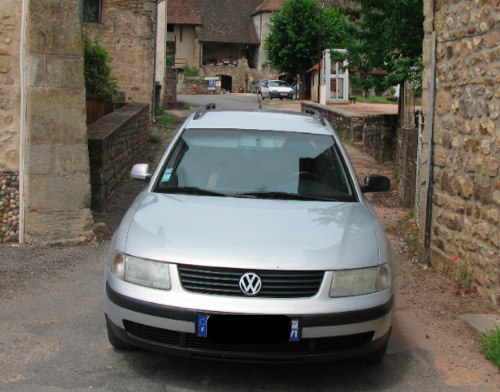
Going through my photos from the last 5 months, I came across this one which I had forgotten.

photograph by ChigyTweeter
published under a Creative Commons Attribution-NonCommercial-ShareAlike license.

It's taken in a back street in St Flour and shows this car stopped in the middle of the road. As I watched the car drew up and a guy got out and went into a medical centre with some package or other. His car sat there in the middle of the road holding up others for several minutes.

It's obvious from the photo that he was effecting several cars. In Cluny he would have driven up onto the pavement, in Nice the hooting would have been deafening, in South Africa it would spark racial jibes - while here he just put his hazards on and went about his business.

Wednesday, September 28, 2011

Taking in Fuel For The Winter

This is something foreign to a South African!

The House at La Gros Chigy is centrally heated with a fuel oil burning system that also supplies hot water to the house and now was the time to take on the oil necessary to last until we return. Getting the fuel to the tank was easy.

FuelTransfer
photograph by ChigyTweeter
published under a Creative Commons Attribution-NonCommercial-ShareAlike license.


The two more difficult things were getting the right amount of fuel into the tank and getting the tanker back on its rounds.

Having no idea how much fuel we had used I went to measure the tank and calculate the consumption from the level readings I had taken. BUt this was no simple cylindrical tank, but a design with two rectangular tanks connected by three vertical much smaller tanks. According to the fuel man this was a design that ensured the strength of the tank but made its volume "incalculable".

So we filled 1000l into the tank in 200 l batches and measured the depth reading on the meter. These readings and some fiddling with a spreadsheet should allowe me to get a rough idea of the size of the tank and our the consumption since we first took in fuel.

The difficulty in getting the tanker back on its route was simpler and only about squeezing out to the St Andre road.

TankerSqueezing
photograph by ChigyTweeter
published under a Creative Commons Attribution-NonCommercial-ShareAlike license.


Having worked for a community group trying to maintain the high standards that control building in our suburb, I find this picture interesting. In our suburb all roads have a 2m sidewalk between the road and the property boundary. Then each property has a limit of some meters (1.5 to 7) on how close they can build to this boundary. Here we have two buildings built right up to the road.

The difference of course is the epoch in which the buildings in the picture were built. It was before cars, let alone fuel tankers! Also the original buildings were farm houses grouped into a community rather than a planned urban development.

Friday, June 10, 2011

Narrow Roads & Streets

Coming back to The House at Le Gros Chigy yesterday afternoon we came across this in the road.

Farm trafic on a narrow rural road.
photograph by ChigyTweet
published under a Creative Commons Attribution-NonCommercial-ShareAlike license.


With a bit of maneuvering onto the grass we managed to pass each other and continue on our ways.

It did get me to thinking about the difficulties of driving on French rural roads, especially while focussing on driving on the right hand side. As one moves off the motorways onto the as and progressively less important roads they get narrower and narrower

kwintessential defines the roads as:
Autoroutes, are highways with many lanes and a divider. Most highways require you to pay a toll to drive on them. Autoroutes in France are given the designation A and are marked by blue road signs showing a divided highway. These open roads in France are designed for long distance high speed inter city driving in France and many of them have petrol stations and rest areas with restaurants on the way.

Routes Nationals: These open roads in France are given the designation N and are well signposted main highways equipped with reflectors to aid night driving.

Routes Departmentales: These are secondary and tertiary local roads which begin with a D. They are smaller and not suitable for open road high speed driving over long distances.

Routes Communales: These are minor rural roads, not designed for high speed driving, although the fact that there are very few cars on them means that high speed driving, while illegal, may be possible. These roads begin with a C and are maintained by local communes who are the local government authorities in France.


Many roads are of a width that both cars need to have their left wheels just on the edge of the tarred surface or just off. This means what normally happens is when you see a car you slow down and edge apart. However, there are always those who are in a rush and you tend to meet on the corner - this is rather worrying for someone battling to find their position on a narrow road.

Then there are the really narrow roads where there is only tar for one car and the verge to the hedge or wall is so small that you have to find a place to pull off, allow the other car to pass and then continue.

This is even more the norm in villages where buildings right on the road or parked cars reduce the road to a single lane.

Narrow village streets cause vehicles to stop and wait
photograph by ChigyTweet
published under a Creative Commons Attribution-NonCommercial-ShareAlike license.