Showing posts with label history. Show all posts

Saturday, July 20, 2013

Things To Do In The Clunisois Area

The image below is from a map showing Cluny and surroundings, which can be found on the Cluny Tourism Information Office website. The darker brown area which we call the Clunisois Area (Communauté de communes du Clunisois) offers a range of attractions centered on Cluny a major religious centre of the Middle Ages.

Click Image to Download Complete Map

The map shows the villages within a short distance of The House at Le Gros Chigy that have interesting buildings and facilities although the keys to these is not on this extract. Click the map to access the full PDF document with the key.

Although even the church and grounds of a little village church like Massey are interesting, Cluny, Brancion, Cormatin and St Hippolyte are better known and offer more to the visitor.

The map is well worth downloading or getting a copy of as it holds much useful information.

Wednesday, September 28, 2011

Taking in Fuel For The Winter

This is something foreign to a South African!

The House at La Gros Chigy is centrally heated with a fuel oil burning system that also supplies hot water to the house and now was the time to take on the oil necessary to last until we return. Getting the fuel to the tank was easy.

FuelTransfer
photograph by ChigyTweeter
published under a Creative Commons Attribution-NonCommercial-ShareAlike license.


The two more difficult things were getting the right amount of fuel into the tank and getting the tanker back on its rounds.

Having no idea how much fuel we had used I went to measure the tank and calculate the consumption from the level readings I had taken. BUt this was no simple cylindrical tank, but a design with two rectangular tanks connected by three vertical much smaller tanks. According to the fuel man this was a design that ensured the strength of the tank but made its volume "incalculable".

So we filled 1000l into the tank in 200 l batches and measured the depth reading on the meter. These readings and some fiddling with a spreadsheet should allowe me to get a rough idea of the size of the tank and our the consumption since we first took in fuel.

The difficulty in getting the tanker back on its route was simpler and only about squeezing out to the St Andre road.

TankerSqueezing
photograph by ChigyTweeter
published under a Creative Commons Attribution-NonCommercial-ShareAlike license.


Having worked for a community group trying to maintain the high standards that control building in our suburb, I find this picture interesting. In our suburb all roads have a 2m sidewalk between the road and the property boundary. Then each property has a limit of some meters (1.5 to 7) on how close they can build to this boundary. Here we have two buildings built right up to the road.

The difference of course is the epoch in which the buildings in the picture were built. It was before cars, let alone fuel tankers! Also the original buildings were farm houses grouped into a community rather than a planned urban development.

Sunday, July 3, 2011

Musicians at the Fête Médiévales de Mont-Saint-Vincent

The main attraction at the Fête was probably the fighting of the knights, but I am going to have a look at some of the musicians who were performing there. For more on the knights have a look at the article in Le Journal se Soane-et-Loire.

Our first stop at the Faire was a group playing close to the entrance with some interesting instruments.

Aperture
photograph by ChigyTweet
published under a Creative Commons Attribution-NonCommercial-ShareAlike license.


The group was expanded with more players during the day and entertained continually.


Another pair of musicians walked the streets singing traditional folk songs and entertaining the younger visitors with this interesting form of puppets!


Just for the record here's a photo of the knights lined up at the start of the jousting!

Knights lined up before the jousting
photograph by ChigyTweet
published under a Creative Commons Attribution-NonCommercial-ShareAlike license.


Friday, May 20, 2011

"Now and Then" Photographs

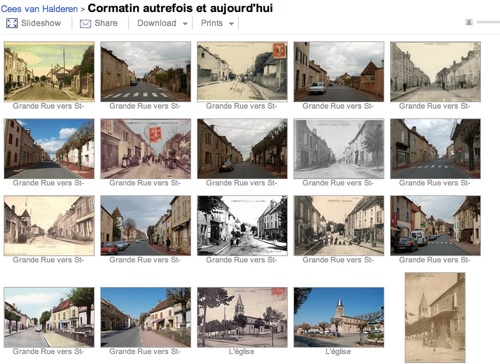
A while back I made a couple of attempts at showing how the view of the Chigy Chateau shown in old postcards compares to what's there today. If you remember I searched through photos I had taken to find a view that showed more or less what the postcard showed and then A Friend went to the trouble of taking a photograph which I published.

But for the real "autrefois et aujourd'hui" have a look at this

Cormatin autrefois et aujourd hui  Cees van Halderen  Picasa Web Albums
click image to visit site


These were taken by Cees van Halderen who writes the blog Life around Cormatin, Taizé, Cluny - Burgundy. This blog gives a really interesting and informative view of happening and things in the area, as seen by a Netherlander.

I am amazed at the effort this photographic project must have taken - I wonder if he's looking to do more, maybe in other villages.

Friday, December 31, 2010

Comparing Churches in Massy and Nylstroom

When we stopped in Nylstroom for lunch on our way to the Waterberg, we parked in the grounds of the Dutch Reformed Church for our picnic. I took a few photographs of the church and its surroundings, one of which you see below.

The Dutch Reformmed church built in Nylstroom in 1898.
photograph by ChigyTweet
published under a Creative commons Attribution-NonCommercial-ShareAlike license.

The church is interesting for many reasons, firstly for being situated in Nylstroom which was founded in the 1860s by a Voortrekker group known as the Jerusalem Trekkers who aiming to trek to the Holy Land. Following the maps at the back of their Bibles they believed they had reached the Nile river and decided to stay.

The Dutch Reformed Church was built in 1898 and is the oldest church in sub-saharan Africa north of Pretoria. The church was also used as a hospital during the Second Boer War and was near a British concentration camp 544 lives were lost.

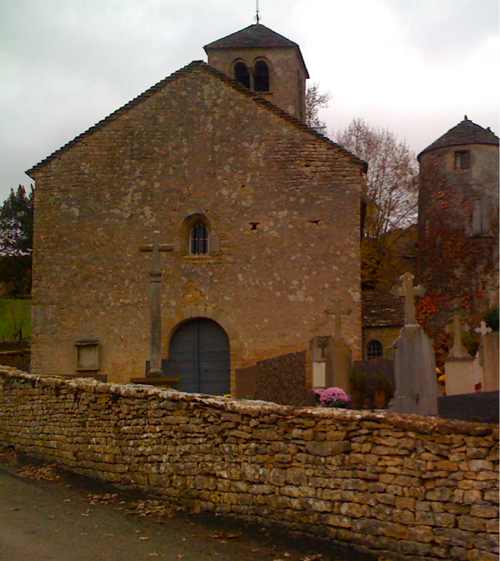
Compare this to the Saint Denis in Massy from my last post,

Saint_Denis_in_Massy.jpg
photograph by ChigyTweet
published under a Creative commons Attribution-NonCommercial-ShareAlike license.

which was built sometime between the years 1030 and 1040. It was Constructed to replace a chapel thought to be too old and too little it still stands almost 1 000 years later and was already more than 800 years old when work started on the Nylstroom Church

The roof of the church is supported by a wood frame that was covered in 1708. The altar dates to the period of Louis XV and sits atop another altar that might date to when the church was built.

On the outside of Saint-Denis the most striking feature is the church’s bell tower with it’s descriptive Lombard Bands and the zigzag stone work.

Concepts of age, history and craftsmanship are vastly different in the two "towns"

Monday, November 22, 2010

The Link to Oil Milling at The House at Le Gros Chigy

I did notice a light circular shape in the "terrace" outside the dining room at La Gros Chigy, but did not give it any real thought, until the previous owner visited and we discussed the house, its history and construction.

The oil mill milstone embedded in the patio at the House in La Gros Chigy.
photo by ChigyTweet
(Creative Commons Some Limitations License)


Its interesting that the previous owner believes the original house is around 300 years old. The previous owner originally occupied only what is now the kitchen and the first two bedrooms with the area south of that still being a barn.

When they converted the barn into an extension to the house, they added the "terrace". At the time the owner's daughter had "rescued" a millstone from the old vegetable oil mill that the family had apparently run in La Gros Chigy.

The millstone, which is not part of modern industrial oil mills, is used to grind the material from which the oil is to be extracted. This breaks down the structure of the material and frees the oil which coagulates forming droplets. This process takes around 30 minutes and is followed by pressing. A press exerts pressure on the ground seeds and squeezes the oil out of the press from where it is collected.

This type of mill is still used widely in the olive oil industry, especially for the speciality more natural oils.

So thats the story of the white round object in the patio!